

Monday, August 2, 2010


Friday, July 23, 2010


Thursday, July 15, 2010


Greece's debt auction : An uneasy calm : Panic about the euro zone has receded—for now


An uneasy calm
Panic about the euro zone has receded—for now
The Economist Jul 15th 2010
MOST people are not satisfied with mediocrity. But Greece’s auction of six-month treasury bills on July 13th turned inferiority into a cause for celebration. The beleaguered country managed to raise €1.6 billion ($2 billion) at a yield of 4.65% in its first venture into the markets since a €110 billion rescue package from the European Union and the IMF was secured in May.
That is hardly dazzling. The yield was still higher than when Greece issued similar paper in April, before the bail-out package was announced, and over three times what it was in January. Germany’s one-year bills yield ten times less than Greece’s six-month ones (see chart). Short-term bill auctions to roll over maturing debt are encouraged in the deal reached by Greece, the EU and the fund but the threat of an eventual debt restructuring makes investors unwilling to lend for long. Greece’s public-debt agency was forced to drop plans to auction 12-month bills. It is unlikely that Greece will attempt a sale of longer-term bonds before early 2012, and it may find few willing buyers even then because of the country’s increased debt burden.
The auction was nevertheless a relief. The yield was lower than the 5% interest rate Greece pays when it taps into the EU support package. The auction was 3.64 times oversubscribed. Although it was mostly a domestic affair, Petros Christodoulou, the debt agency’s director, says he was “pleasantly surprised by foreign investors’ demand”. Greece will try to raise up to €2.5 billion in an issue of three-month paper on July 20th.
Greece has also been getting pats on the back from its EU and IMF lenders for its progress on fiscal consolidation. George Papaconstantinou, the finance minister, this week announced that the country’s first-half budget deficit had been cut by 46% compared with last year, beating targets. On July 8th the Greek parliament passed a pension-reform bill which, if properly implemented, will radically change the country’s lavish social-security system. Credit-default-swap spreads on Greek debt have fallen to a one-month low.
The sunnier mood is not just confined to Greece. Portugal issued six-month paper earlier this month at a modest yield of 1.95%; this week’s decision by Moody’s to downgrade the country caused few ripples. Spain raised €6 billion in ten-year bonds on July 6th, tempting bids from China, among others. Laurent Fransolet of Barclays Capital says that “some of the hysterical reactions we saw in April and May have calmed down.” These developments have contributed to a rise in the euro to a two-month high against the dollar. But a bigger test of sentiment is looming. The announcement of the stress-test results for 91 European banks, due on July 23rd, will show whether the calm can endure or whether it preceded a storm.
Saturday, May 1, 2010
Sunday, April 25, 2010
Volcanic fallout : The ban on flights caused anger among airlines and chaos for travellers
 The effect on business and leisure
Volcanic fallout
The ban on flights caused anger among airlines and chaos for travellers
Apr 22nd 2010 | From The Economist print edition
Welcome back
BY THE early hours of April 15th, Britain’s air-traffic controllers feared the worst. They had hoped the wind would carry the ash from Eyjafjallajokull south-east of the country, but the wind had changed. Guided by computer models used by volcanic-ash watchers at the Met Office, the air-traffic agency said it was withdrawing service. British airspace was closed.
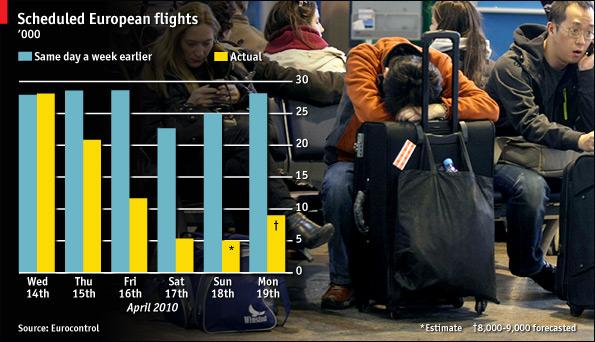
As the ash cloud spread eastwards, northern Europe’s airports shut down one by one, stranding millions of passengers, many of them attempting to return from Easter holidays, all over the world. On April 17th nearly 17,000 flights to and from Europe were cancelled out of about 22,000 on a normal day. With weather forecasts suggesting that the cloud might not budge for five days and talk of months of disruption, desperate travellers began trying to get home by any means possible.
Trains and coaches filled up; car-rental firms were ransacked for vehicles, despite rocketing prices; the most affluent and impatient hired taxis to drive them home or to Channel ports. A rail strike in France did not help. Britain’s prime minister, Gordon Brown, mindful of the general election next month, said three naval vessels would be sent to rescue stranded Britons abroad. (Only one was.) Those stuck in the Americas or Asia could try to get an over-booked flight to southern Europe and then strike north over land or just sit it out.
Meanwhile, the airlines were becoming more and more restless. Some suspected that the models used to justify the flight ban were based on sketchy data and incomplete science. IATA, their trade body, claimed the disruption was costing them up to $400m a day in lost revenues and passenger compensation. European airlines are obliged to provide hotels and food for passengers awaiting re-routing, and European airports say they have lost €250m ($336m). IATA’s boss, Giovanni Bisignani, said governments were not basing their actions on fact: “We must”, he said, “make decisions based on the real situation in the sky, not on theoretical models.”
Dozens of test flights by airlines reported no damage to aircraft or engines. British Airways’ pugnacious boss, Willie Walsh, who was aboard one of the flights, said: “Since airspace was closed…our assessment is that the risk has been minimal.” Airlines, he said, were best placed to assess the risks to aircraft, crew and passengers.
Other airline bosses agreed with Mr Walsh. Both BA and KLM, after all, had direct experience of what flying through volcanic ash can do to a high-bypass turbofan jet engine. In 1982 a BA flight hit a cloud of ash over an Indonesian volcano and all four engines stopped. In 1989 a KLM 747 survived a similar experience over Alaska. These incidents led directly to today’s European safety procedures.
By the time European transport ministers finally met, by video conference, on the morning of the 19th, airlines were up in arms. The European Union’s transport commissioner, Siim Kallas, promised greater co-ordination between the 38 member states of Eurocontrol, the body supposed to integrate air navigation services across Europe, and a more dynamic approach to risk assessment. Planes would be allowed to fly through the thinner parts of the plume. The next day, restrictions were eased across much of Europe and flights began. But the no-fly zone still applied to most of Britain, and a new cloud of volcanic ash was reported to be on its way.
Mr Walsh’s patience with what he saw as foot-dragging by Britain’s regulator, the Civil Aviation Authority (CAA), was at its limit. He ordered 26 BA planes at different long-haul destinations to be flown to their London bases, Heathrow and Gatwick. The gamble worked. At first British air-traffic controllers told the approaching aircraft that they would not be allowed to land, but at 8pm the CAA suddenly announced that “new guidance” would allow “a phased reintroduction” from 10pm. There would still be some no-fly zones, but they would be much smaller and did not cover Britain. Flying, according to the British government’s chief scientific adviser, John Beddington, was “completely safe” again. Although airlines gave warning that it would take several days for services to return to normal and for all passengers to be flown home, the crisis was over.
The blame game, however, was only just beginning. Last year, in the grip of the recession, Europe’s airlines lost $3.8 billion. IATA was forecasting a loss of $2.2 billion this year, but its chief economist, Brian Pearce, now thinks the figure will be nearer to $4 billion. BA was losing £20m ($31m) a day and Air France-KLM half as much again; even Dubai-based Emirates lost $50m in the first five days of disruption. The bigger airlines had enough cash to survive for a while, but demands for state compensation—and for changes to costly passenger-rights rules—are growing.
In the longer term, Mr Bisignani believes that the past week’s events will spur completion of the “Single European Sky”, an attempt to pool sovereignty over airspace. The airlines want Europe to adopt a system for dealing with volcanic-ash eruptions similar to that in America, where the Federal Aviation Authority gives carriers information and data but lets them make their own risk assessments. Europe now seems to be heading that way. The CAA’s revised guidance says airlines should conduct their own risk assessments, look for ash damage before and after flights and report any incidents to the regulator.
Gauging the economic impact of the crisis is as difficult as predicting when and where the next cloud of ash will appear. Industries other than travel have been little affected. Almost all the world’s freight goes by sea, rail and road. That said, the 2% by volume that goes by air accounts for around 35% of the value: light, expensive goods such as high-end electronic components tend to be flown. Exporters of perishables, such as flower and vegetable producers in Kenya, suffered immediate damage. An estimated $8m-worth of blooms have been destroyed and several thousand casual workers sent home. Carmakers were beginning to worry about interrupted supplies of electrical components from Asia slowing production lines.
According to Bruno Sidler, the chief operating officer of CEVA, which manages logistics and freight for companies in 170 countries, European manufacturers are vulnerable to any big supply shock because they have run down their inventories over the past two years to conserve cash. However, their response to dodging a bullet this time, he thinks, will not be to rebuild their supply chains but to “take a chance on this not happening again.” That will be the reaction of many people—even the holidaymakers caught in the chaos.

Tuesday, April 20, 2010



Subscribe to:
Posts (Atom)